

In the global race for tech talent, Israel has long been a powerhouse of innovation, producing world-class engineers and sales professionals. However, as companies scale and expand their Go-To-Market (GTM) teams, one question remains at the forefront of every hiring manager’s mind: How do salaries actually compare?
At Risch Results, we track global compensation trends to help our clients build competitive teams. If you are comparing tech sales compensation between the United States and Israel, the data shows a significant and widening gap.
The High-Level View: A 50% to 100% Premium
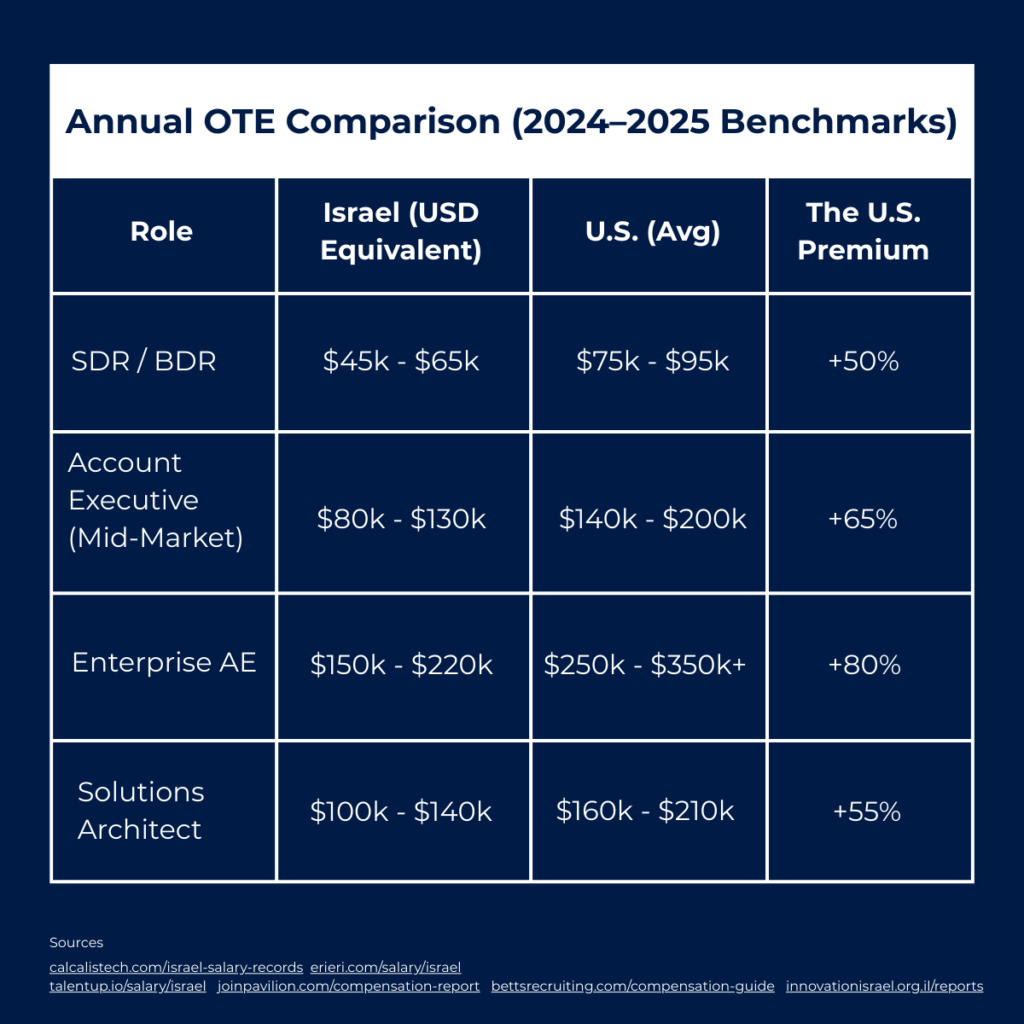
While Israeli tech salaries are among the highest in Europe and the Middle East, they still trail U.S. benchmarks significantly. On average, a tech sales professional in the U.S. earns 50% to 100% more in total On-Target Earnings (OTE) than their counterpart in Israel.
Beyond the Base: Why the Gap Exists
It isn’t just about the base salary. The way compensation is structured in the U.S. versus Israel changes the “earning ceiling” for high performers.
1. The 50/50 Split and Aggressive Accelerators
In the U.S., the standard for Account Executives is a 50/50 split (50% base, 50% commission). This structure often comes with aggressive “accelerators”—if a rep hits 110% of their quota, their commission rate might double. In Israel, structures are often more conservative (e.g., 60/40 or 70/30), providing more stability but capping the massive upside seen in American “Tier 1” hubs like San Francisco or NYC.
2. The Equity Factor
U.S.-based tech giants and late-stage startups frequently use Restricted Stock Units (RSUs) as a primary retention tool. For an Enterprise AE in the U.S., an annual RSU grant can add $30,000 to $100,000+ to their total compensation package—a level of equity compensation that is less common in the Israeli domestic market.
3. The “Social Cost” Buffer
It is important to note that Israeli salaries often include “social costs” that aren’t reflected in the gross pay. This includes Keren Hishtalmut (a tax-free study fund) and mandatory pension contributions. While these provide long-term financial security, they don’t offer the immediate liquidity of a high U.S. commission check.
What This Means for Hiring Teams
For Israeli startups looking to hire their first U.S. sales lead, the “sticker shock” is real. To attract top-tier talent in the American market, companies must be prepared to pay U.S. market rates rather than attempting to bridge the gap with Israeli benchmarks.
Conversely, for U.S. companies looking to build a presence in Israel, the market offers a highly skilled, multilingual, and technically savvy workforce at a significantly lower cost-per-head than equivalent talent in Austin, Boston, or San Jose.
Our Data Sources
This analysis is based on 2024 and 2025 compensation data from the following industry leaders:
Betts Recruiting: Tech Sales Compensation Guide 2024 bettsrecruiting.com/compensation-guide
Israel Innovation Authority: High-Tech Employment Report 2025 innovationisrael.org.il/reports
Pavilion: Executive & Associate Compensation Report 2024 joinpavilion.com/compensation-report
ERI (Economic Research Institute): Israel Salary Database 2025 erieri.com/salary/israel
Ctech by Calcalist: Israel High-Tech Salary Trends 2025 calcalistech.com/israel-salary-records
TalentUp:Tech Sales Global Benchmarking 2025 talentup.io/salary/israel
At Risch Results, we remove the guesswork from global hiring. We utilize LaborIQ, a premier compensation analytics platform that leverages 18 trillion data points and real-time payroll validation, to ensure our clients have the most accurate, location-specific salary benchmarks in the U.S. market.
LaborIQ Salary Benchmarking Overview
This video provides an overview of how LaborIQ uses real-time data and payroll validation to help companies identify pay gaps and set competitive salary benchmarks.
Are you an Israeli company looking to scale your team into the US?
Contact Risch Results today to learn how we can help you navigate the complexities of US hiring and compensation.